
Can I File A Claim If Road Debris Caused My Motorcycle Crash?

Road debris accidents are surprisingly common in San Diego, and often complex. Unlike a typical collision between two vehicles, liability isn’t always immediately clear. While the driver who lost the load is often at fault, it’s not always that simple. Establishing negligence requires proving that the responsible party failed to secure their cargo properly, violating California traffic laws. This means gathering evidence – police reports, witness statements, photos of the debris and the vehicle it came from, and potentially even the truck’s maintenance records.
One of the biggest hurdles in these cases is identifying the responsible party. Sometimes, the driver isn’t immediately apparent. The debris might have originated from a construction site, a landscaping truck, or even another vehicle that didn’t stop at the scene. Thorough investigation is crucial, and that’s where an experienced attorney can make all the difference. We’ve successfully tracked down responsible parties in cases where the initial police report offered no leads, utilizing traffic camera footage and even social media to identify the vehicle involved.
As a personal injury attorney practicing in San Diego for over 13 years, I’ve seen firsthand how insurance companies attempt to minimize payouts in road debris cases. I was trained by a former insurance defense attorney, giving me intimate knowledge of how these companies evaluate, devalue, and deny claims. They’ll often argue that the debris was unavoidable, that Alistair was traveling too fast, or that his motorcycle wasn’t properly maintained. These tactics are designed to shift blame and reduce their financial responsibility.
What evidence do I need to collect after a motorcycle accident caused by road debris?
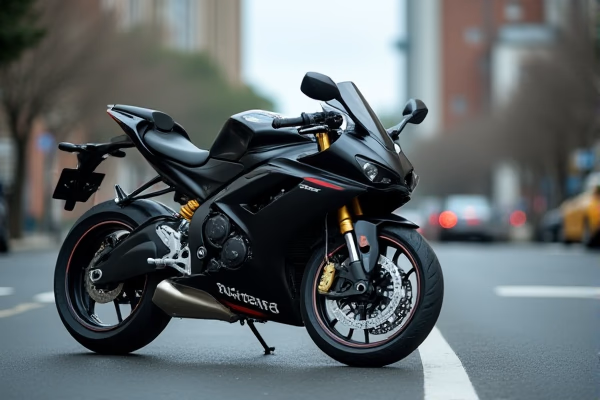
Documenting the scene is paramount. Immediately after the crash, if you are able, use your smartphone to photograph everything: the debris itself, the location of the debris in the road, the damage to your motorcycle, and any visible injuries you sustained. Obtain the police report number and request a copy as soon as it’s available. If there were any witnesses, get their contact information. Even seemingly insignificant details – the time of day, weather conditions, and road surface – can be crucial later on.
Beyond the immediate scene, gather any medical records related to your injuries, including emergency room reports, doctor’s notes, and physical therapy bills. Keep a detailed log of all expenses incurred as a result of the accident, such as motorcycle repairs, lost wages, and medication costs. Finally, if you remember any details about the vehicle that lost the load – make, model, color, license plate number – write them down immediately while they’re still fresh in your mind.
Can I sue the government if road debris caused my crash on a public road?
If the road debris was the result of a government-owned vehicle or a hazardous condition on a public road – like potholes or poorly maintained construction zones – the process is different. In California, you are required to file a formal administrative claim with the government agency responsible within **6 months** (180 days) of the accident. This is a strict deadline under the Government Tort Claims Act, and failure to meet it can result in the permanent loss of your right to recover. “…if a motorcycle accident involves a government-owned vehicle or a dangerous road condition like loose gravel, potholes, or poorly marked construction zones, a formal administrative claim **MUST** be presented within **6 months** (180 days). Failure to meet this strict deadline under the Government Tort Claims Act can result in the permanent loss of your right to recover.”
What if the driver who lost the load doesn’t have insurance?
This is a common scenario, unfortunately. If the at-fault driver is uninsured or underinsured, you may be able to pursue a claim under your own Uninsured Motorist (UM) coverage. “…California law requires insurers to offer Uninsured Motorist (UM) and Underinsured Motorist (UIM) coverage. For motorcyclists hit by a driver with minimum or no insurance, this coverage allows you to recover damages directly from your own policy up to your selected limits.” UM coverage is designed to protect you in situations like this, providing compensation for your medical bills, lost wages, and pain and suffering. It’s important to review your policy to understand the limits of your coverage and the steps required to file a claim.
How does comparative fault apply in road debris accidents?
California operates under a ‘pure’ comparative fault system. This means that even if you were partially at fault for the accident – perhaps you were traveling slightly above the speed limit – you can still recover damages. However, your total compensation will be reduced by your percentage of fault. For example, if you were found to be 20% at fault, you would only be able to recover 80% of your total damages. Insurance companies will often attempt to argue that you contributed to the accident to reduce their payout. “…California’s ‘pure’ comparative fault system applies to motorcycle claims. Even if a driver argues you shared responsibility due to speed or positioning, you can still recover damages; however, your total compensation will be reduced by your percentage of fault.”
What should I expect during a recorded statement with the insurance company?
Insurance companies will almost always request a recorded statement after an accident. While you are not legally obligated to provide one, they will often present it as a necessary step in the claims process. It’s crucial to understand that these statements are designed to gather information that can be used against you. They’ll ask leading questions, attempt to downplay your injuries, and look for inconsistencies in your account of the accident. I strongly advise against providing a recorded statement without first consulting with an attorney. We can prepare you for the questions you’ll be asked and ensure that your rights are protected.