Can I Recover Damages If I Was Partially At Fault For The Motorcycle Accident?

The immediate concern in any motorcycle accident is securing medical attention and reporting the incident. But a very common follow-up question, especially when a rider acknowledges some degree of responsibility, is whether they’ve completely forfeited their right to compensation. The answer, thankfully, is usually no. California operates under a principle called “pure comparative fault,” which means you can still recover damages even if you were partially to blame.
However, understanding how comparative fault works is crucial. It doesn’t mean you’ll receive the full amount of your damages. Instead, your recovery will be reduced by your percentage of fault. For example, if your total damages are $100,000 and a jury determines you were 30% at fault, you would only receive $70,000. This is why a thorough investigation and skilled legal representation are essential to minimize your assigned fault.
I’ve been practicing personal injury law in San Diego for over 13 years, and I’ve seen countless cases where insurance companies attempt to inflate a rider’s percentage of fault to reduce their payout. Having been trained by a former insurance defense attorney, I have intimate knowledge of how these companies evaluate claims, devalue injuries, and deny legitimate compensation. They’ll scrutinize every aspect of the accident, looking for any evidence to support their argument that you were more responsible than you actually were.
What evidence can be used to determine my percentage of fault in a motorcycle accident?
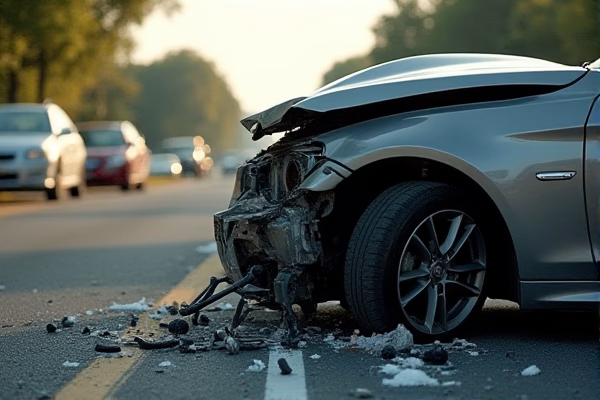
Determining fault isn’t simply a matter of admitting you were speeding or made a mistake. Insurance adjusters and juries will consider a wide range of evidence. This includes police reports, witness statements, photographs of the accident scene, and even expert testimony reconstructing the events. Crucially, they’ll also examine the actions of the other driver. Were they distracted? Did they violate traffic laws? Was their vehicle properly maintained?
Dashcam footage, if available, is incredibly valuable. Even if you have a camera, the other driver’s footage or nearby surveillance cameras can provide crucial insights. Additionally, the “black box” data from your motorcycle’s electronic control module (ECM) or the other vehicle’s event data recorder (EDR) can reveal speeds, braking patterns, and other critical information. Preserving this evidence is paramount, as it can easily be lost or overwritten.
How does California’s pure comparative fault system work in practice?
California’s Civil Code § 1714 establishes the framework for comparative negligence. Unlike some states that bar recovery if you’re even 1% at fault, California allows you to recover damages as long as you weren’t 100% responsible for the accident. The percentage of fault is assigned to each party involved, and your recovery is reduced accordingly. This means even if you bear significant responsibility, you may still be entitled to substantial compensation for your medical bills, lost wages, pain and suffering, and other damages.
What if the insurance company claims I was entirely at fault?
Insurance companies often start with a position of zero liability on their end and 100% fault on the rider. It’s their business model. Don’t automatically accept their assessment. A skilled attorney will thoroughly investigate the accident, gather evidence, and build a strong case to challenge their claims. This may involve hiring accident reconstruction experts, interviewing witnesses, and obtaining medical records to demonstrate the extent of your injuries and the impact the accident has had on your life.
Can I negotiate with the insurance company on my own?
While you technically *can* negotiate with the insurance company yourself, it’s generally not advisable. Adjusters are trained negotiators who are skilled at minimizing payouts. They’ll likely try to take advantage of your lack of legal experience and pressure you into accepting a settlement that’s far less than what your case is worth. Having an attorney level the playing field and advocate for your best interests is crucial to maximizing your recovery.
What if the other driver was uninsured or underinsured?
If the at-fault driver lacks adequate insurance coverage, you may be able to pursue a claim under your own Uninsured Motorist (UM) or Underinsured Motorist (UIM) coverage. California Insurance Code § 11580.2 requires insurers to offer these protections. UM/UIM coverage can provide compensation for your medical bills, lost wages, and pain and suffering, even if the other driver has no insurance or insufficient coverage to cover your damages. However, navigating these claims can be complex, and it’s essential to have an attorney familiar with the intricacies of UM/UIM policies.
What should I do if I receive a recorded statement request from the insurance company?
Insurance companies frequently request recorded statements from claimants. While you’re not legally obligated to provide one, doing so can be detrimental to your case. Adjusters are trained to ask leading questions designed to elicit admissions that can be used to reduce your payout. It’s best to politely decline the request and consult with an attorney before speaking to the insurance company. An attorney can advise you on whether to provide a statement and, if so, how to prepare for it.
How long do I have to file a lawsuit for a motorcycle accident in California?
California law provides a **two-year** window from the date of the motorcycle accident to file a lawsuit for personal injury. Because evidence at a crash scene—such as skid marks or GoPro footage—can disappear quickly, immediate filing is critical to preserve the integrity of the claim. CCP § 335.1 outlines these statute of limitations rules. Don’t delay seeking legal counsel, as missing the deadline can result in the permanent loss of your right to recover.
What if the accident involved a government vehicle or a dangerous road condition?
If a motorcycle accident involves a government-owned vehicle or a dangerous road condition like loose gravel, potholes, or poorly marked construction zones, a formal administrative claim **MUST** be presented within **6 months** (180 days). Failure to meet this strict deadline under the Government Tort Claims Act can result in the permanent loss of your right to recover. Gov. Code § 911.2 details these requirements.
What role does lane splitting play in determining fault?
California law formally recognizes lane splitting as legal, defined as driving a motorcycle between rows of stopped or moving vehicles in the same lane. In accident litigation, proving that the maneuver was performed ‘in a safe and prudent manner’ is essential to rebutting claims of rider negligence. CVC § 21658.1 provides the legal basis for lane splitting, but the burden of proof remains on the rider to demonstrate they acted reasonably and responsibly.
Is wearing a helmet required in California, and how does it affect my claim?
California is a universal helmet law state, requiring all riders and passengers to wear a safety helmet that meets DOT standards. While a violation may be used by defense counsel to argue for a reduction in damages via comparative fault—specifically regarding head or neck injuries—it does not bar a rider from seeking recovery for other injuries caused by a negligent driver. CVC § 27803 outlines the helmet requirements.
What if I was injured while delivering food or ridesharing on my motorcycle?
If a motorcycle delivery driver or bike courier is injured on the job, they are entitled to workers’ compensation. However, workers’ compensation is generally the **exclusive remedy** against the employer, though separate claims may exist against negligent third-party drivers. Labor Code § 3600 governs workers’ compensation claims.