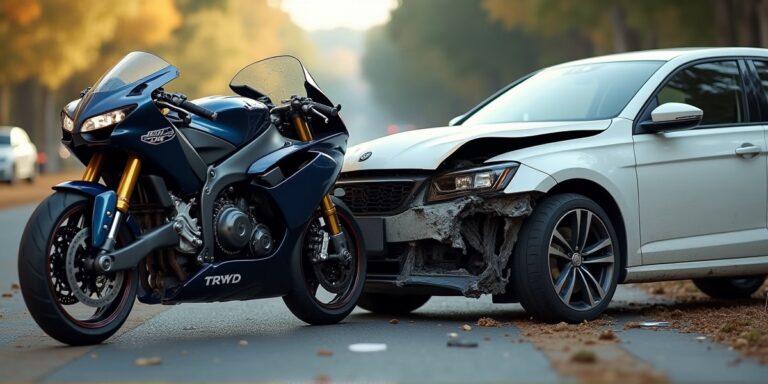
Can I Sue If The Driver Says They Never Saw My Motorcycle?

The assertion that a driver “didn’t see” a motorcycle is a common defense tactic, but it rarely absolves them of responsibility. California law places a duty of care on all drivers to maintain a proper lookout and operate their vehicles safely. Simply not seeing a motorcyclist doesn’t automatically mean the driver was not negligent. In fact, it often *points* to negligence – a failure to observe the surroundings, a distraction, or driving too fast for conditions.
Establishing liability in these cases requires a thorough investigation. We’ll examine police reports, witness statements, and the accident scene itself. Crucially, we’ll analyze whether the driver should have seen you, given the visibility, weather conditions, and traffic patterns. Often, the lack of visibility is used as a scapegoat, but a skilled investigator can demonstrate that a reasonable driver would have been able to avoid the collision.
As a personal injury attorney with over 13 years of experience practicing in San Diego, I’ve seen this scenario play out countless times. I was trained by a former insurance defense attorney, giving me intimate knowledge of how insurance companies evaluate, devalue, and deny claims. They are masters at shifting blame and minimizing payouts. That’s why having an advocate who understands their tactics is essential.
What evidence is most helpful when the driver claims they didn’t see my motorcycle?
Several types of evidence can be critical in proving liability when a driver claims they didn’t see you. Police reports are a starting point, but often lack the detail needed to fully reconstruct the accident. Witness statements are invaluable, especially if they corroborate your account of the events. Photos and videos of the accident scene, including any dashcam footage from your motorcycle or nearby vehicles, can provide objective evidence of the driver’s actions.
Additionally, we’ll look at the driver’s cell phone records to determine if they were distracted at the time of the crash. Even seemingly minor distractions can have devastating consequences. Accident reconstruction experts can also analyze the impact dynamics to determine the speed and trajectory of both vehicles, helping to establish fault. Finally, the motorcycle’s Event Data Recorder (EDR) can provide valuable data about braking and acceleration.
How does California law define a driver’s duty of care to motorcyclists?
California law, specifically CVC § 21801, requires all drivers to exercise reasonable care while operating their vehicles. This includes maintaining a proper lookout, obeying traffic laws, and anticipating potential hazards. Drivers are expected to scan the road ahead, check their mirrors, and be aware of their surroundings at all times.
The legal standard is not perfection, but rather what a “reasonable person” would do under similar circumstances. This means considering factors like traffic density, weather conditions, and the time of day. If a driver failed to meet this standard of care, and that failure caused the accident, they can be held liable for your injuries.
What if the driver was speeding or otherwise violating traffic laws?
If the driver was speeding, running a red light, or engaging in other illegal behavior, it significantly strengthens your case. These violations are considered “negligence per se,” meaning they automatically establish a breach of duty of care. We’ll obtain the driver’s driving record and any available evidence of their traffic violations.
Even if the driver wasn’t violating a specific law, evidence of reckless driving – such as aggressive lane changes or tailgating – can demonstrate a disregard for safety and contribute to a finding of negligence. In these situations, the insurance company may be more willing to negotiate a fair settlement.
Can I still recover damages if I was partially at fault for the accident?
Yes, California operates under a “pure” comparative fault system, meaning you can still recover damages even if you shared some responsibility for the accident. However, your total compensation will be reduced by your percentage of fault. For example, if you were 20% at fault, you can still recover 80% of your damages. Civ. Code § 1714 governs this process.
Insurance companies often try to inflate a motorcyclist’s percentage of fault to minimize their payout. That’s why it’s crucial to have an experienced attorney who can thoroughly investigate the accident and present a strong defense of your actions. We’ll carefully analyze all evidence to ensure you receive the maximum compensation you deserve.
What should I do immediately after a motorcycle accident where the driver claims they didn’t see me?
The immediate aftermath of a motorcycle accident is critical. First, prioritize your safety and seek medical attention, even if you don’t feel seriously injured. Next, exchange information with the driver, including their insurance details. However, avoid making any statements about fault or apologizing for the accident.
Document everything you can, including photos of the accident scene, vehicle damage, and your injuries. Obtain the names and contact information of any witnesses. Most importantly, contact an experienced personal injury attorney as soon as possible. We can guide you through the legal process, protect your rights, and ensure you receive the compensation you deserve.
What is the statute of limitations for filing a motorcycle accident claim in California?
In California, you generally have **two years** from the date of the motorcycle accident to file a lawsuit for personal injury. Because evidence at a crash scene—such as skid marks or GoPro footage—can disappear quickly, immediate filing is critical to preserve the integrity of the claim. CCP § 335.1 outlines these deadlines.
Waiting too long to file a claim can result in the permanent loss of your right to recover damages. Don’t delay – contact an attorney as soon as possible to discuss your options and ensure your claim is filed within the statutory timeframe.
What if the accident involved a government vehicle or a dangerous road condition?
If a motorcycle accident involves a government-owned vehicle or a dangerous road condition like loose gravel, potholes, or poorly marked construction zones, a formal administrative claim **MUST** be presented within **6 months** (180 days). Failure to meet this strict deadline under the Government Tort Claims Act can result in the permanent loss of your right to recover. Gov. Code § 911.2 details these requirements.
These claims are often complex and require specific documentation and procedures. An experienced attorney can help you navigate the process and ensure your claim is properly filed and presented to the government entity.
What if the other driver was uninsured or underinsured?
If the at-fault driver has minimum or no insurance, you may be able to recover damages through your own Uninsured Motorist (UM) or Underinsured Motorist (UIM) coverage. Ins. Code § 11580.2 requires insurers to offer this coverage.
UM/UIM claims can be complex and often require arbitration. An experienced attorney can help you understand your policy limits, navigate the arbitration process, and maximize your recovery.
What role does lane splitting play in determining fault?
California law formally recognizes lane splitting as legal, defined as driving a motorcycle between rows of stopped or moving vehicles in the same lane. In accident litigation, proving that the maneuver was performed ‘in a safe and prudent manner’ is essential to rebutting claims of rider negligence. CVC § 21658.1 provides the legal framework.
Insurance companies often attempt to blame the rider for lane splitting, even if the driver was primarily at fault. We’ll gather evidence to demonstrate that you were operating your motorcycle safely and responsibly, and that the driver’s negligence caused the accident.