
How Do I Get My Eld Data After A San Diego Truck Accident?

As a personal injury attorney practicing in San Diego for over 13 years, I’ve seen this scenario play out far too often. Trucking companies, trained by former insurance defense attorneys like myself, understand the power of Electronic Logging Devices (ELDs) and will do everything possible to control access to that data. ELDs are essentially the “black boxes” of the trucking industry, recording a driver’s hours of service, speed, location, and other critical information. Obtaining this data is often the key to proving negligence and maximizing your recovery.
The problem is, unlike the flight data recorders in airplanes, there’s no independent agency automatically preserving ELD data after a truck accident. The trucking company controls the information, and they have a vested interest in protecting themselves. They may claim the data is lost, corrupted, or only available through a lengthy and expensive legal process. This is why acting quickly and strategically is paramount.
I was previously employed by a large insurance defense firm, giving me intimate knowledge of how these companies evaluate, devalue, and deny claims. They know that ELD data can reveal violations of federal Hours of Service regulations, speeding, and other unsafe practices. Their goal is to delay, deny, or minimize your claim, and controlling the ELD data is a major part of that strategy.
What steps should I take to get the ELD data after a San Diego truck accident?
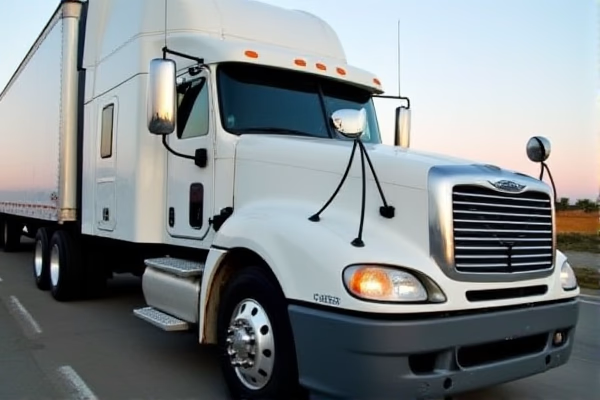
The first step is to immediately send a formal “spoliation letter” to the trucking company. This letter, drafted by an attorney, demands the preservation of all relevant evidence, including the ELD data, the driver’s logbooks (if any), maintenance records, and any internal communications related to the accident. It also puts them on notice that destroying or altering evidence could result in severe legal consequences.
Next, we’ll investigate the specific ELD system used by the truck. Different systems have different data retention policies and methods of access. Some systems allow for remote data downloads, while others require physical access to the device. We’ll also identify the driver’s hours of service leading up to the accident to determine if they were in compliance with federal regulations. A violation of these regulations is strong evidence of negligence.
Finally, we’ll work with accident reconstruction experts to analyze the ELD data and determine the truck’s speed, location, and other critical factors at the time of the collision. This data can be used to establish liability and prove the extent of your damages.
What if the trucking company refuses to provide the ELD data?
If the trucking company refuses to cooperate, we can file a lawsuit and subpoena the ELD data through the discovery process. This is a legal order compelling them to produce the information. However, even with a subpoena, there can be delays and challenges. The trucking company may try to argue that the data is lost, corrupted, or irrelevant. That’s why it’s crucial to act quickly and preserve any evidence you can independently.
We can also consider filing a motion to compel the production of the data if they continue to resist. The court can then issue an order forcing them to comply. In some cases, we may even be able to obtain a court order allowing us to inspect the truck and download the data directly.
It’s important to remember that the trucking company has a legal obligation to preserve evidence. Failing to do so can result in sanctions, including adverse inferences at trial. This means the jury can assume the missing evidence would have been unfavorable to their case.
Can I get the ELD data myself?
While you can request the ELD data yourself, it’s unlikely the trucking company will cooperate without a formal legal demand. They are not obligated to provide you with this information, and they may try to take advantage of your lack of legal expertise. Attempting to obtain the data yourself could also inadvertently compromise your case.
Furthermore, ELD data is often complex and requires specialized software and expertise to analyze. Simply obtaining the data is not enough; you need to be able to interpret it correctly and present it effectively in court. That’s why it’s essential to work with an experienced attorney who understands the intricacies of trucking litigation.
Trying to navigate this process alone can be overwhelming and detrimental to your claim. An attorney can handle all the legal complexities and ensure you have the evidence you need to maximize your recovery.
What if the accident involved a government vehicle or roadway hazard?
If the truck accident involved a government-owned vehicle or a dangerous road condition maintained by a public entity, a formal administrative claim **MUST** be presented within **6 months** (180 days). Failure to meet this strict deadline under the Government Tort Claims Act can result in the permanent loss of your right to recover. This is a completely separate process from pursuing a claim against the trucking company, and it’s crucial to understand the specific requirements and deadlines.
The claim must be filed with the appropriate government agency and include detailed information about the accident, including the location, date, and time, as well as the names and contact information of any witnesses. It’s also important to document any evidence of the road hazard, such as photos, videos, or witness statements.
An attorney can help you prepare and file the administrative claim, ensuring it meets all the necessary requirements and deadlines. They can also represent you throughout the claims process and negotiate a fair settlement on your behalf.
What should I do if the insurance company asks me to give a recorded statement?
Insurance companies often request recorded statements from accident victims shortly after a collision. While you are not legally obligated to provide a statement, doing so can be detrimental to your claim. Insurance adjusters are trained to ask leading questions and elicit information that can be used to devalue or deny your claim.
They may try to get you to admit fault, minimize your injuries, or provide information about your medical history. It’s best to politely decline the request and consult with an attorney before speaking to the insurance company. An attorney can advise you on whether to provide a statement and, if so, how to prepare for it.
Remember, the insurance company is not on your side. Their goal is to protect their bottom line, and they will use any means necessary to minimize their payout. Don’t let them take advantage of you.
What if I believe the driver was misclassified as an independent contractor?
California’s ‘ABC test’ determines if a delivery driver (Amazon/FedEx) is an employee or contractor. Even if labeled a ‘contractor,’ a company may be liable if they exercise control over the driver’s work, a key factor in San Diego delivery truck litigation. Misclassification is common in the gig economy, and it can have significant implications for your claim.
If the driver was misclassified as an independent contractor, the trucking company may be liable for their negligence under the doctrine of respondeat superior. This means they can be held responsible for the driver’s wrongful acts, even if they were not directly involved in the accident.
An attorney can investigate the driver’s employment status and determine if they were properly classified. They can also gather evidence of the company’s control over the driver’s work, such as scheduling requirements, performance standards, and training protocols.