
What Happens If Companies Ignore Safety Violations?

When trucking companies knowingly disregard safety regulations, they put everyone on the road at risk. These violations aren’t simply paperwork errors; they directly contribute to accidents and the severe injuries that follow. While the Federal Motor Carrier Safety Administration (FMCSA) attempts to enforce compliance, it’s often up to injured victims and their attorneys to uncover these systemic issues and hold the responsible parties accountable.
The legal ramifications for companies that ignore safety violations are substantial. Beyond the immediate costs of a lawsuit—medical bills, lost income, and pain and suffering—they can face punitive damages designed to punish egregious misconduct and deter future negligence. This is where a thorough investigation, including a review of the company’s safety records, driver qualifications, and maintenance logs, becomes paramount.
As a personal injury attorney with over 13 years of experience practicing in San Diego, I’ve seen firsthand how insurance companies attempt to downplay the significance of safety violations. Trained by a former insurance defense attorney, I understand their tactics and how they evaluate, devalue, and deny claims. I’ve built my practice on uncovering the truth and fighting for the maximum compensation my clients deserve.
What Evidence Can Prove a Company Ignored Safety Violations?
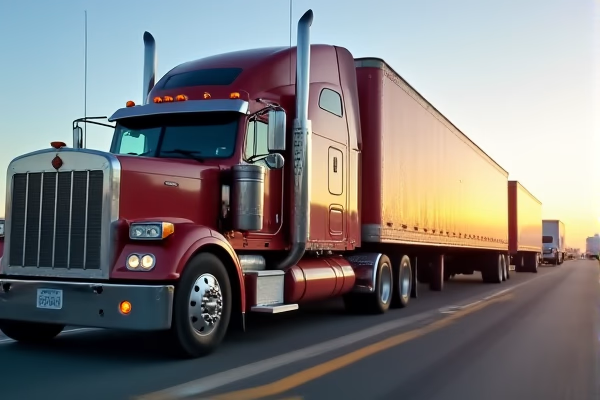
Establishing that a trucking company ignored safety violations requires a multi-faceted approach. We begin by obtaining the company’s Motor Carrier Safety Record (MCSR) from the FMCSA, which details their safety history, including inspections, violations, and crash reports. This record can reveal a pattern of non-compliance, such as repeated brake defects, hours-of-service violations, or unqualified drivers.
Beyond the MCSR, we’ll investigate the driver’s logbooks, maintenance records, and training files. Falsified logbooks are a common tactic used to conceal hours-of-service violations, and inadequate training can demonstrate a lack of due diligence in ensuring driver competence. We also look for any internal company policies or memos that indicate a disregard for safety protocols.
Dashcam footage, if available, can provide crucial evidence of the driver’s actions leading up to the crash. Electronic Logging Device (ELD) data can verify hours-of-service compliance, and maintenance records can reveal whether the truck was properly inspected and repaired. In San Diego truck accident cases, we often subpoena these records directly from the company and the driver.
Can I Sue the Trucking Company Even if the Driver Was at Fault?
Yes, absolutely. Under the doctrine of **vicarious liability** (respondeat superior), a principal is responsible to third persons for the negligence of their agent in the transaction of business. This means the trucking company can be held legally liable for the wrongful acts of its drivers committed within the scope of their employment. Civ. Code § 2338
However, proving the company’s negligence is key. We must demonstrate that the company was negligent in its hiring, training, supervision, or retention of the driver. This could involve showing that the company knew or should have known about the driver’s unsafe driving habits or that they failed to conduct a thorough background check.
Even if the driver was primarily at fault, the company may still be liable for a significant portion of the damages, particularly if they were negligent in their oversight. This is why it’s crucial to consult with an attorney experienced in trucking litigation to explore all potential avenues of recovery.
What if the Trucking Company Claims the Driver Was an Independent Contractor?
Determining whether a driver is an employee or an independent contractor is a complex legal issue. Trucking companies often misclassify drivers as independent contractors to avoid liability for their actions. However, California’s ‘ABC test’ determines if a delivery driver (Amazon/FedEx) is an employee or contractor. Labor Code § 2775
Under this test, a worker is presumed to be an employee unless the company can prove they meet specific criteria, including that the driver owns their own business, controls their own work schedule, and performs services outside the company’s usual course of business. If the company exercises significant control over the driver’s work, such as dictating routes, schedules, or equipment, they may be deemed an employer.
Even if labeled a ‘contractor,’ a company may be liable if they exercise control over the driver’s work, a key factor in San Diego delivery truck litigation. We’ll thoroughly investigate the driver’s relationship with the company to determine their proper classification and hold the responsible parties accountable.
What are the Penalties for Trucking Companies That Violate Federal Regulations?
The penalties for trucking companies that violate federal regulations can be severe, ranging from fines and suspension of operating privileges to criminal charges in cases of gross negligence. The FMCSA has the authority to impose civil penalties for a wide range of violations, including hours-of-service violations, inadequate maintenance, and unsafe driving practices.
Federal **Hours of Service (HOS)** regulations dictate exactly how long a driver can be behind the wheel. Violations of these federal safety standards, often proven through Electronic Logging Device (ELD) data, are used to demonstrate driver fatigue. 49 CFR § 395
In addition to FMCSA penalties, trucking companies can also face lawsuits from injured victims seeking compensation for their damages. These lawsuits can result in significant financial losses, including medical bills, lost income, and pain and suffering. The cumulative effect of these penalties can be devastating for a trucking company’s bottom line.
How Long Do I Have to File a Lawsuit After a Truck Accident?
California law provides a **two-year** window from the date of the truck accident to file a lawsuit. CCP § 335.1 Because trucking companies often begin evidence destruction (like purging ELD data) as soon as the law allows, immediate filing is critical to preserve the integrity of the claim.
This two-year statute of limitations begins to run on the date of the accident, regardless of when you discover the company’s safety violations. It’s crucial to consult with an attorney as soon as possible to initiate an investigation and ensure your claim is filed within the deadline. Delaying can jeopardize your right to recover compensation.
Furthermore, if a government-owned vehicle or a dangerous road condition maintained by a public entity was involved, a formal administrative claim **MUST** be presented within **6 months** (180 days). Gov. Code § 911.2 Failure to meet this strict deadline under the Government Tort Claims Act can result in the permanent loss of your right to recover.