
What Inspection Records Are Required For Commercial Trucks?

Commercial truck accidents are inherently complex. Unlike collisions involving passenger vehicles, these cases often involve multiple parties – the driver, the trucking company, the freight broker, and potentially even the maintenance provider. A critical component of successfully navigating these claims is understanding the inspection records required for commercial trucks. These records aren’t just paperwork; they are often the key to proving negligence and holding the responsible parties accountable.
Federal and California regulations mandate rigorous inspection procedures for commercial vehicles. These aren’t simply suggestions; they are legally binding requirements designed to ensure the safety of everyone on the road. A failure to comply with these regulations can be a strong indicator of negligence, and a thorough review of inspection records is often the first step in building a strong case. We’ve seen countless instances where inadequate maintenance, documented in deficient inspection reports, directly contributed to a truck accident.
I’ve been practicing personal injury law in San Diego for over 13 years, and I’ve dedicated a significant portion of my practice to representing individuals injured in truck accidents. Having been trained by a former insurance defense attorney, I possess intimate knowledge of how insurance companies evaluate, devalue, and deny claims. This insight allows me to anticipate their tactics and build a robust case on behalf of my clients.
What types of inspection records should I be looking for?
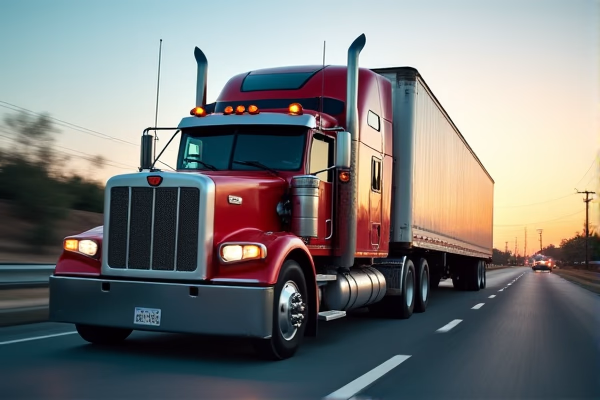
There are several key inspection records that are crucial in a truck accident case. The first is the **Driver Vehicle Inspection Report (DVIR)**. This report is completed by the driver before and after each trip, documenting the condition of the vehicle. It covers everything from brakes and tires to lights and steering. A missing or incomplete DVIR, or one that fails to identify a known defect, can be powerful evidence of negligence. Additionally, there are **periodic maintenance inspections**, which are more comprehensive checks performed by a qualified mechanic. These inspections are required at regular intervals, and the records should detail any repairs or maintenance performed.
Beyond these, it’s important to look for records of **brake inspections**, **tire inspections**, and **cargo securement inspections**. Each of these has specific requirements under federal and California law. The Federal Motor Carrier Safety Administration (FMCSA) maintains detailed regulations regarding these inspections, and any deviation from these standards can be a sign of negligence. Finally, don’t overlook **repair orders** and **maintenance logs**. These documents can provide valuable insight into the history of the vehicle and any recurring mechanical issues.
How can I obtain these inspection records?
Obtaining these records can be challenging, as they are typically held by the trucking company or their maintenance provider. A formal **records request** is usually the first step. This request should be specific and detailed, outlining exactly what records you are seeking. However, trucking companies are often reluctant to provide this information voluntarily. In many cases, a **subpoena** is necessary to compel them to produce the records. We routinely utilize the discovery process, including depositions and interrogatories, to gather this critical evidence.
What if the trucking company claims they don’t have the records?
It’s not uncommon for trucking companies to claim they don’t have the records, or that they have been lost or destroyed. However, this doesn’t necessarily mean the case is over. Federal regulations require trucking companies to retain these records for a specific period of time. If they can’t produce the records, it can create a presumption of negligence. Furthermore, we can explore other avenues for obtaining the information, such as contacting the mechanic who performed the inspections or seeking data from the vehicle’s Electronic Logging Device (ELD). It’s important to remember that the burden of proof often lies with the trucking company to demonstrate they complied with safety regulations.
What does a missing or incomplete inspection report mean for my case?
A missing or incomplete inspection report can be incredibly damaging to the trucking company’s defense. It suggests they failed to properly maintain the vehicle and may have been aware of a defect that contributed to the accident. This can be used to establish negligence and increase the value of your claim. Even if the report is present, a thorough review can reveal inconsistencies or red flags. For example, if a report indicates a brake issue was identified but not repaired, it can be strong evidence of negligence. We meticulously analyze these reports, looking for any indication of a failure to comply with safety regulations.
How does the ELD data factor into inspection requirements?
Electronic Logging Devices (ELDs) have become increasingly prevalent in the trucking industry, and the data they generate can be invaluable in a truck accident case. ELDs record a driver’s hours of service, speed, and other critical information. Violations of federal Hours of Service regulations, often revealed through ELD data, can be a strong indicator of driver fatigue and negligence. Furthermore, ELD data can be used to verify the accuracy of the driver’s logbook and identify any discrepancies. We work with forensic experts to analyze ELD data and uncover any evidence of safety violations.
What if the accident involved a government-owned vehicle or roadway?
If a truck accident involves a government-owned vehicle or a dangerous road condition maintained by a public entity, a formal administrative claim **MUST** be presented within **6 months** (180 days). Failure to meet this strict deadline under the Government Tort Claims Act can result in the permanent loss of your right to recover. These claims require specific documentation and a detailed account of the accident. It’s crucial to consult with an attorney immediately to ensure you comply with all applicable deadlines and requirements.
What is the statute of limitations for filing a truck accident lawsuit in California?
California law provides a **two-year** window from the date of the truck accident to file a lawsuit. Because trucking companies often begin evidence destruction (like purging ELD data) as soon as the law allows, immediate filing is critical to preserve the integrity of the claim. Delaying can significantly impact your ability to recover compensation. We prioritize prompt investigation and filing to protect our clients’ rights.
What if the driver was an independent contractor, not an employee of the trucking company?
Determining whether a driver is an employee or an independent contractor can be complex. California’s ‘ABC test’ determines if a delivery driver (Amazon/FedEx) is an employee or contractor. Even if labeled a ‘contractor,’ a company may be liable if they exercise control over the driver’s work, a key factor in San Diego delivery truck litigation. We carefully analyze the driver’s relationship with the trucking company, looking for evidence of control, supervision, and integration into the company’s operations.
What if the trucking company is trying to get me to give a recorded statement?
Insurance companies often request recorded statements from accident victims. While you are not legally obligated to provide a statement, doing so can be detrimental to your case. Insurance adjusters are trained to ask leading questions and elicit information that can be used to devalue your claim. It’s best to politely decline the request and consult with an attorney before speaking with the insurance company. We can handle all communication with the insurance company on your behalf.
What happens if I have medical liens from my treatment?
Medical liens are claims against your settlement or judgment to cover the cost of your medical treatment. These liens can significantly reduce the amount of compensation you receive. We work with healthcare providers to negotiate and resolve medical liens, often reducing the amount owed. Understanding the priority of different liens (ER bills vs. medical liens) is crucial in maximizing your recovery.
What is vicarious liability and how does it apply to trucking accidents?
Under the doctrine of **vicarious liability** (respondeat superior), a principal is responsible to third persons for the negligence of their agent in the transaction of business. This holds the trucking company legally liable for the wrongful acts of its drivers committed within the scope of their employment. Even if the driver was at fault, the trucking company can be held responsible for their actions.