Can A Driver Be Liable For Failing To Yield To A Motorcycle?

California law places a significant responsibility on drivers to be aware of their surroundings and to exercise reasonable care when interacting with motorcycles. This isn’t simply a matter of courtesy; it’s a legal obligation. Drivers must actively scan for motorcycles, understand their smaller profile, and anticipate their movements. A failure to do so, resulting in a collision, can form the basis of a negligence claim.
The concept of “yielding” extends beyond simply stopping at a stop sign or traffic light. It encompasses a broader duty to ensure the safety of motorcyclists when changing lanes, merging onto highways, or making turns. Drivers must check their mirrors, blind spots, and be prepared to adjust their speed or position to avoid a collision. The law doesn’t require perfection, but it does demand a reasonable level of attentiveness and caution.
I’ve spent over 13 years representing injured motorcyclists in San Diego, and I’ve seen firsthand how insurance companies often attempt to shift blame onto the rider. Having been trained by a former insurance defense attorney, I intimately understand how they evaluate claims, devalue injuries, and deny legitimate payouts. They’ll scrutinize every detail, looking for any opportunity to minimize their liability. That’s why it’s crucial to have an advocate who understands their tactics and can effectively counter their arguments.
What evidence can prove a driver failed to yield to my motorcycle?
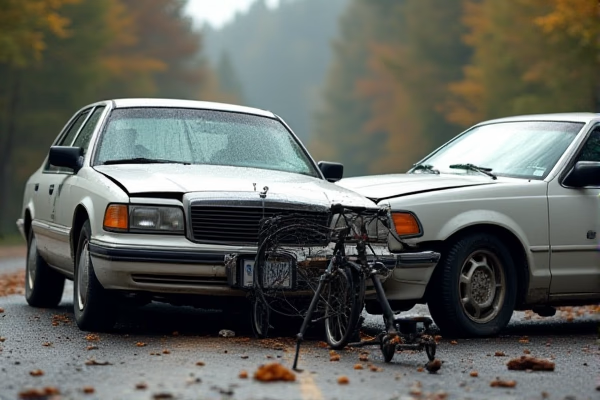
Establishing that a driver failed to yield requires gathering compelling evidence. This can include police reports, witness statements, and, crucially, the physical evidence from the crash scene. Skid marks, vehicle damage, and the position of the motorcycles and other vehicles can all provide valuable clues. However, some of the most powerful evidence comes from independent sources.
Dashcam footage, if available, is incredibly persuasive. Even better, data from the vehicles’ Event Data Recorders (EDR), also known as “black boxes,” can reveal critical information about speed, braking, and steering inputs leading up to the collision. We often work with accident reconstruction experts to analyze this data and create a clear picture of what happened. Additionally, any video surveillance from nearby businesses or traffic cameras can be invaluable.
Finally, the driver’s own statements, obtained through a recorded statement (discussed further below), can be incredibly revealing. It’s important to remember that insurance companies often attempt to downplay the driver’s negligence, so securing independent evidence is paramount.
What if the driver claims they didn’t see my motorcycle?
The argument that a driver “didn’t see” a motorcycle is a common defense tactic, but it doesn’t automatically absolve them of responsibility. Drivers have a duty to maintain a proper lookout and be aware of their surroundings, regardless of whether they actually saw a motorcycle. Negligence isn’t about what a driver *did* see; it’s about what they *should* have seen.
We can counter this argument by demonstrating that the driver was distracted, speeding, or otherwise acting carelessly. Evidence of cell phone use, erratic driving behavior, or a history of traffic violations can all be used to establish negligence. Furthermore, we can argue that a reasonably attentive driver *would* have seen the motorcycle under the prevailing conditions.
California’s lane splitting laws, as defined in CVC § 21658.1, further complicate this issue. If you were lane splitting at the time of the accident, proving that you did so safely and prudently is essential to rebutting claims of rider negligence.
How does California’s comparative fault system affect my claim if I was partially at fault?
California operates under a “pure” comparative fault system, meaning you can recover damages even if you were partially responsible for the accident. However, your total compensation will be reduced by your percentage of fault. For example, if you are found to be 30% at fault, you can still recover 70% of your damages.
Insurance companies will aggressively attempt to establish your comparative fault, often focusing on factors like speed, lane positioning, or failure to wear a helmet. It’s crucial to have an attorney who can thoroughly investigate the accident and counter their arguments. While a violation of CVC § 27803 regarding helmet use may be used to argue for a reduction in damages, it does not automatically bar a claim.
We’ll meticulously review all evidence, including witness statements, police reports, and accident reconstruction data, to minimize your percentage of fault and maximize your recovery. Remember, even a seemingly minor contribution to the accident can significantly reduce your compensation.
What is the statute of limitations for filing a motorcycle accident claim in California?
California law provides a **two-year** window from the date of the motorcycle accident to file a lawsuit for personal injury. Because evidence at a crash scene—such as skid marks or GoPro footage—can disappear quickly, immediate filing is critical to preserve the integrity of the claim. Waiting too long can jeopardize your ability to recover compensation.
This two-year deadline is strict, and there are limited exceptions. It’s important to consult with an attorney as soon as possible after an accident to ensure you meet all applicable deadlines. We can handle all the necessary paperwork and filings to protect your rights.
Furthermore, if the accident involved a government-owned vehicle or a dangerous road condition, the deadline for filing a claim is even shorter, as outlined in Gov. Code § 911.2. Failure to meet this strict deadline can result in the permanent loss of your right to recover.
What should I do if the insurance company asks me to give a recorded statement?
Insurance companies often request recorded statements from claimants shortly after an accident. While you are not legally obligated to provide a statement, doing so can be detrimental to your claim. Insurance adjusters are trained to ask leading questions designed to minimize their liability and gather information that can be used against you.
It’s best to politely decline the request and refer the insurance company to your attorney. We can handle all communications with the insurance company on your behalf and ensure your rights are protected. We will conduct our own thorough investigation and gather the evidence necessary to build a strong case, without exposing you to the risks of a recorded statement.
Remember, the insurance company is not on your side. Their primary goal is to minimize their payout, and they will use every tactic at their disposal to achieve that goal. Having an experienced attorney by your side can level the playing field and ensure you receive the compensation you deserve.