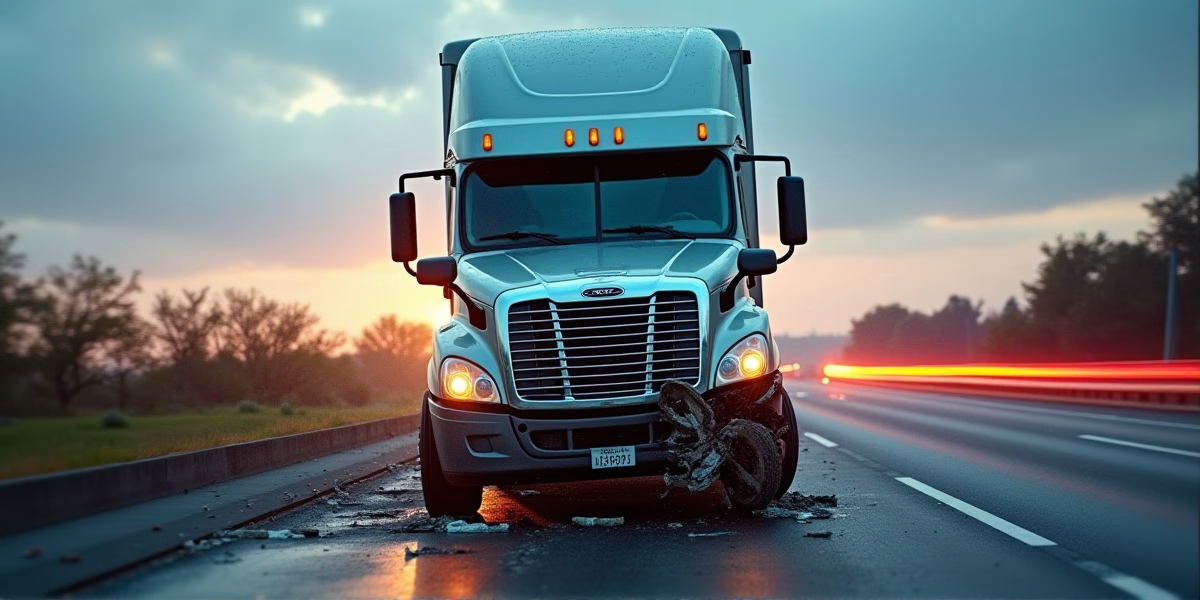
How Do Lawyers Investigate Truck Accidents With Multiple Vehicles?

Investigating truck accidents involving multiple vehicles presents unique challenges compared to standard car crashes. The sheer number of parties involved—drivers, trucking companies, potentially cargo loaders, mechanics, and even government entities—creates a web of potential liability. It’s not enough to simply gather police reports; a comprehensive investigation requires a proactive, multi-faceted approach focusing on both the immediate scene and the long-term operational history of all involved parties.
One of the first steps is securing the scene, if possible. This means documenting everything: photographs of vehicle damage, road conditions, skid marks, and the position of all vehicles. Witness statements are crucial, but they can be unreliable over time. We immediately dispatch investigators to locate and interview witnesses while their memories are fresh. Equally important is obtaining the truck’s Event Data Recorder (EDR), often called a “black box,” which records critical data like speed, braking, and steering inputs leading up to the crash. This data is often overwritten quickly, making prompt retrieval essential.
I’ve been practicing personal injury law in San Diego for over 13 years, and I’ve seen firsthand how insurance companies attempt to minimize their exposure in these complex cases. I was trained by a former insurance defense attorney, giving me intimate knowledge of how they evaluate, devalue, and deny claims. They will often focus on blaming the other drivers, downplaying the truck driver’s role, and challenging the extent of your injuries. That’s why it’s critical to have an attorney who understands their tactics and can build a strong case on your behalf.
What types of evidence are crucial in a multi-vehicle truck accident investigation?
Beyond the initial police report and witness statements, several types of evidence are critical. The truck’s maintenance records are vital; federal regulations require trucking companies to meticulously document all inspections and repairs. We subpoena these records to identify any pre-existing mechanical issues that may have contributed to the accident. Similarly, the driver’s logs (ELD data) are essential to verify compliance with Hours of Service regulations. Violations of these regulations are a strong indicator of negligence.
We also investigate the cargo itself. Was it properly secured? An improperly loaded or secured load can shift during transit, causing the truck to become unstable and lose control. Furthermore, we examine the trucking company’s safety record, including any prior accidents, violations, and complaints filed against them. This information can reveal a pattern of negligence and demonstrate a systemic failure to prioritize safety.
How do you determine fault when multiple parties are involved?
Determining fault in a multi-vehicle truck accident often requires reconstructing the accident. This involves using forensic experts to analyze the physical evidence, including vehicle damage, skid marks, and the position of the vehicles. They can create a computer simulation of the accident to determine the sequence of events and identify the primary cause. California’s comparative fault rules (Civ. Code § 1714) come into play here, meaning that even if you were partially at fault, you may still be able to recover damages, although your recovery will be reduced by your percentage of fault.
It’s important to understand that fault isn’t always clear-cut. Multiple parties may share responsibility, and establishing the precise degree of fault for each party requires a thorough investigation and expert analysis. We work with accident reconstruction specialists, biomechanical engineers, and other experts to build a compelling case that accurately reflects the circumstances of the accident.
What role do federal regulations play in truck accident investigations?
Federal regulations, outlined in 49 CFR § 395, govern nearly every aspect of trucking operations, from driver qualifications and hours of service to vehicle maintenance and cargo securement. Violations of these regulations are often a key factor in truck accident investigations. For example, if a driver was operating outside of their allowed hours of service, it’s a strong indication of negligence. Similarly, if a truck was not properly maintained, it can be used to establish liability against the trucking company.
We meticulously review all relevant federal regulations to identify any violations that may have contributed to the accident. This requires a deep understanding of the complex regulatory framework governing the trucking industry. Our firm has extensive experience navigating these regulations and using them to build a strong case on behalf of our clients.
What if the truck driver was an independent contractor, not an employee?
Determining whether a truck driver is an employee or an independent contractor can significantly impact liability. California’s ‘ABC test’ (Labor Code § 2775) is used to make this determination. Even if a driver is labeled as a contractor, a company may still be liable if they exercise control over the driver’s work. This is a complex legal issue that often requires expert testimony.
We investigate the relationship between the driver and the trucking company to determine the level of control the company exercised. Factors such as the company’s control over the driver’s schedule, routes, and equipment are all considered. If we can establish that the driver was effectively an employee, the company may be liable for their negligence.
What should you do immediately after a multi-vehicle truck accident?
If you’ve been involved in a multi-vehicle truck accident, it’s crucial to take immediate steps to protect your rights. First, seek medical attention, even if you don’t feel immediately injured. Some injuries may not be apparent until days or weeks later. Second, document everything: photographs of the scene, vehicle damage, and your injuries. Third, and most importantly, contact an experienced attorney as soon as possible. We can guide you through the complex legal process and ensure that your rights are protected.
We understand that dealing with the aftermath of a truck accident can be overwhelming. Our firm is dedicated to providing compassionate and effective legal representation to victims of truck accidents in San Diego. We will handle all aspects of your case, from investigating the accident to negotiating with insurance companies and, if necessary, litigating your claim in court.
What is the statute of limitations for filing a truck accident lawsuit in California?
In California, you generally have **two years** from the date of the truck accident to file a lawsuit (CCP § 335.1). However, because trucking companies often begin evidence destruction (like purging ELD data) as soon as the law allows, immediate filing is critical to preserve the integrity of the claim. Don’t delay seeking legal counsel, as missing this deadline can result in the permanent loss of your right to recover.
We prioritize prompt investigation and filing of lawsuits to ensure that all evidence is preserved and your claim is protected. Our firm has a proven track record of success in handling complex truck accident cases, and we are committed to fighting for the maximum compensation you deserve.
What if the accident involved a government vehicle or a dangerous road condition?
If a truck accident involves a government-owned vehicle or a dangerous road condition maintained by a public entity, a formal administrative claim **MUST** be presented within **6 months** (180 days) under the Government Tort Claims Act (Gov. Code § 911.2). Failure to meet this strict deadline can result in the permanent loss of your right to recover. These claims have very specific requirements, and it’s essential to have an attorney guide you through the process.
Our firm has extensive experience handling claims against government entities, and we understand the unique challenges involved. We will ensure that your claim is properly filed and documented to maximize your chances of success.
What if the truck driver was operating under workers’ compensation?
If a commercial driver is injured on the job in San Diego, they are entitled to workers’ compensation (Labor Code § 3600). However, workers’ compensation is generally the **exclusive remedy** against the employer. Separate personal injury claims are typically limited to **negligent third parties** who are not the employer.
We will investigate all potential sources of liability, including the employer, the trucking company, and any other negligent parties. Even if the driver was covered by workers’ compensation, you may still be able to recover damages from other responsible parties.
What happens if the insurance company offers a policy limits tender?
Insurance companies often attempt to settle claims quickly by offering a policy limits tender. This is an offer to pay the maximum amount of their insurance coverage in exchange for a release of all claims. While it may seem tempting to accept this offer, it’s important to carefully consider whether it adequately compensates you for your injuries and losses. It’s critical to have an attorney review the offer and advise you on whether it’s in your best interest.
We have extensive experience negotiating with insurance companies and maximizing our clients’ recovery. We will thoroughly evaluate your claim and fight for the full compensation you deserve, even if it means taking the case to trial.
How important is preserving evidence, like dashcam footage, in a truck accident case?
Dashcam footage, as well as other digital evidence like ECM/EDR data, telematics, and ELD logs, can be invaluable in a truck accident case. This evidence can provide a clear and objective record of the events leading up to the crash. However, this evidence can be easily lost or destroyed, so it’s crucial to act quickly to preserve it. We will immediately send spoliation letters to all relevant parties, demanding that they preserve all evidence related to the accident.
Our firm understands the importance of evidence preservation and will take all necessary steps to secure the evidence needed to build a strong case on your behalf.